
International schools in Madeira are concentrated in Funchal, the island’s capital, and the choice is a narrow one. This guide compares three options on the same set of fields.
The International School of Madeira teaches the Cambridge Primary Pathway in English, with Portuguese as a subject from Grade 1.
The International Sharing School Madeira is an IB World School that offers the full International Baccalaureate continuum for students aged 3 to 18, making it the only school on the island that can take a child from early years through to university entry without a transfer.
Escola da APEL is a private Portuguese school that also describes itself as an IB International School for its Diploma Programme (IB DP) offering; this international label is scoped to the IB DP and does not describe every course the school offers.
The comparison that follows uses the same seven fields for each: commute and location, your child’s age, teaching language, curriculum continuity, admissions timing, the support each school provides, and total cost.
None of the three is ranked above the others because there’s no fit that holds across all families. What works depends on how old your child is when you arrive, how long you expect to stay, and which university system they’ll eventually apply to.
International Schools in Madeira: Key Takeaways

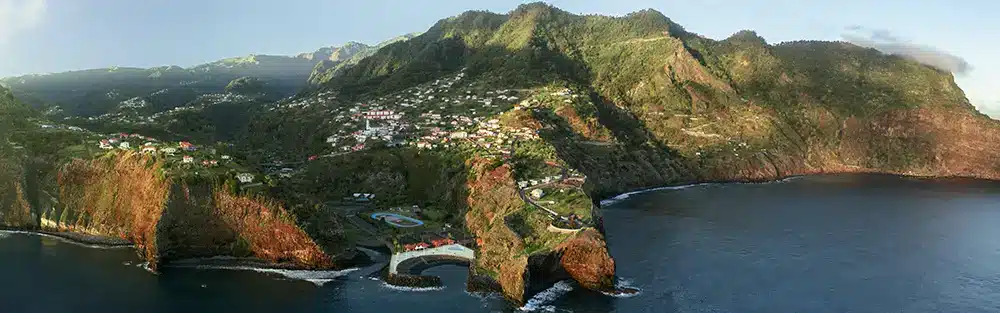
Two schools in Funchal offer a full international education, and they serve different stages of a child’s schooling rather than competing directly for the same student. The profiles below use the same fields for each, so you can compare them on equivalent terms.
For a broader context on how Portugal performs as an educational destination, our Global Intelligence Unit ranked the country 25th in its Global Education Report, which also recorded more than 6 million students studying abroad in 2023 and projected that figure to surpass 10 million by 2030.
International School of Madeira (ISM)
- Curriculum: Cambridge Primary Pathway, covering English, mathematics, science and global perspectives. Grade 4 ends with Cambridge Primary Checkpoint assessments
- Teaching language: English, with Portuguese taught as a subject of its own from Grade 1
- Age range: 3 to 10, from Nursery through Grade 4
- Location: Quinta Martins, Rua da Levada de Santa Luzia 40, Funchal
- Admissions: Application, school visit, an age-appropriate assessment or trial day, offer, then confirmation on payment of the enrollment fee
- Fees: Published by year group for 2026/2027, from €5,520 to €6,240
Source: International School of Madeira, prospectus and fees pages, accessed 9 September 2026.
Founded in 1997, ISM is a registered Cambridge International School and a primary school only. The Cambridge Primary Pathway is taught in English throughout, and Portuguese enters as a subject in its own right from Grade 1, so children build competence in both languages without the academic subjects themselves being delivered bilingually. That distinction matters if you’re choosing between this and a genuinely dual-language model.
The school day runs from 8:00 am to 4:00 pm. Homework clubs run to 4:45 pm and after-school clubs to 5:00 pm, and Early Years children can be collected any time up to 5:00 pm. Weekly swimming, physical education, and art are part of the program for all students, and a hot lunch is available for a monthly charge. Uniform is required.
The field that will decide it for most families is the age range. ISM ends at Grade 4, so children finishing there move on at around age 10, whether to ISS Madeira, a Portuguese school, or a school in another country.
That isn’t a fault, and a settled primary school with internationally benchmarked assessments at the end suits plenty of families. But it commits you to one transfer partway through your child’s education, and it’s worth knowing where that transfer would go before you enroll.
International Sharing School Madeira (ISS Madeira)
Curriculum: International Baccalaureate, full continuum. Primary Years Program, Middle Years Program and Diploma Program
Teaching language: English, stated by the school as its official language of instruction
Age range: 3 to 18
Location: Rua de Santa Luzia 2, Funchal
Admissions: Applications through the school’s enrollment platform, linked from madeira.sharingschool.org
Fees: Published by grade for 2026/2027. See the fees section below.
Source: International Sharing School Madeira, About Us and Tuition Fees pages, accessed 9 September 2026.
ISS Madeira is an IB World School running all three programs, which makes it the only school on the island that can take a child from age 3 through to university entry without a change of school or curriculum. For families who expect to move again, that continuity is the point: a student partway through the IB can pick the program up at any IB school worldwide.
The school dates to 1980, when Susan Farrow founded the Madeira British School. It joined the Sharing Education Group in 2013 and gained IB World School status in 2017. In February 2026, it relocated to a new campus at the Seminário da Encarnação in central Funchal.
For the 2025/2026 year, the school reported more than 250 students, over 35 nationalities, and a teacher-to-student ratio of 1 to 8. Classes are capped at 20, though the school notes this varies with the needs of each group. It’s non-denominational.
The trade-off is cost and commitment. Fees rise steeply through the grades, and the IB Diploma in particular is a demanding two-year program that doesn’t suit every student. If your child is likely to apply to universities in a single country, a national curriculum may serve them just as well at a lower cost.
Escola da APEL is a private Portuguese school that also describes itself as an IB International School for its Diploma Programme (IB DP) offering; this international label is scoped to the IB DP and does not describe every course the school offers.
That distinction is the point of this entry. APEL is an upper-secondary school in Funchal running the Portuguese national curriculum, and its published offering covers scientific-humanistic courses, vocational courses, and education and training courses alongside the IB Diploma.
Only the last of those is an international program, so a child enrolled at APEL is not automatically in international education.
- Curriculum: IB Diploma Program, offered alongside Portuguese national curriculum courses that are not international
- Teaching language: The IB DP is taught in English
- Age range: IB DP for students aged 16 to 19; the school is upper-secondary only
- Location: Caminho dos Saltos 6, Funchal
- Admissions: Completion of year 10 of the Portuguese national curriculum or an equivalent qualification, followed by an interview with the school’s pedagogical directorate
- Fees: €150 pre-registration, €400 enrollment including insurance, and €275 monthly over 10 months, which is €2,750 a year before other costs
Source: Escola da APEL, IB Diploma Programme page and Plano de Estudos 2026/2027, accessed 9 September 2026.
APEL has been an IB World School since 2015/2016. The two-year program replaces the Portuguese curriculum in years 11 and 12 and carries equivalence to Portuguese upper-secondary education, so it fits into the final stage of school rather than replacing the whole of it.
Its assessments are recognized in 150 countries. Students can apply to universities abroad on the IB result without sitting Portuguese national exams, and the same result is accepted for Portugal’s national admissions competition, which keeps both routes open.
For a family arriving with a teenager who has completed year 10 or its equivalent, APEL is a genuine option for the final two years at a materially lower cost than either full international school. It is not a route into international education from an earlier age.

Start with your child’s age, because it eliminates options faster than anything else. A seven-year-old cannot attend APEL. A sixteen-year-old cannot attend ISM. Only one school on the island covers the full range, so for many families, the choice is made before cost or curriculum enters the picture.
Once age has narrowed the field, compare what’s left on the same seven fields.
Sources: each school’s own site, accessed 9 September 2026. Fee schedules change annually and none of these figures guarantees a place.
Location matters more here than the distances suggest. All three are in Funchal, but commutes across the city at school-run times are slower than the map implies, and the school you choose may shape which neighborhood you settle in.
Curriculum continuity is the field families most often underweight. Every transfer costs a child something, and a move between curricula partway through secondary school is harder than a move between schools within one. If you expect to relocate again, weigh this field heavily. If you’re settling permanently, it matters less.
On total cost, compare the full picture rather than the headline tuition. Registration, administration charges, catering, transport, and activities sit outside tuition at all three, and the annual figure rises as your child moves up the grades. Work out the cumulative cost from your child’s current age to the end of school, not the cost of next year.
There is no school here that suits every family, and none of the three is presented as better than the others. What differs is the shape of what they offer, and which shape fits your circumstances.

Each school runs a different process, and none of them guarantees a place at the grade you need.
ISM publishes a five-step route: submit an application, visit the school, attend an age-appropriate assessment or trial day, receive an offer, then confirm by paying the enrollment fee. That fee is €350 on first registration, with an annual administration charge of €350 and an €80 re-enrollment fee thereafter. Catering costs €112 a month, and homework club costs €50. Reductions are available for early payment and for siblings, with the rate confirmed alongside your offer.
ISS Madeira takes applications through its enrollment platform. The enrollment fee is €800, with a €300 renewal fee each February for existing students. Tuition covers stationery, books, art materials, and access to the school’s digital platforms, though students provide their own laptop from Grade 4. Meals, transport, and after-school activities are billed separately.
APEL requires completion of year 10 of the Portuguese curriculum or an equivalent qualification, followed by an interview with the school’s pedagogical directorate. Pre-registration is €150 and enrollment is €400, including insurance, with monthly payments of €275 across 10 months.
What to confirm before you commit
Published figures tell you what this year costs, not what a place is worth holding. Before you decide, ask each school directly about:
- Availability at your child’s specific grade, rather than general admissions status
- The current fee schedule for the coming year, including administration and renewal charges
- Which stage your child would enter, and whether their existing records map onto it
- What happens if your child arrives mid-year or partway through a two-year program
- Whether transport, meals, and activities are included
Ask the same questions of each school so the answers are comparable.
One boundary worth stating plainly: enrolling a child in school and obtaining Portuguese residency are separate processes. A school place does not confer immigration status, and immigration status does not secure a school place. If you are still working out the residency side of your move, our guide to Portugal residency visas covers the options.
The distinction is straightforward. Portuguese public schools are free and teach the national curriculum entirely in Portuguese. The three schools in this guide teach in English and lead to internationally recognized qualifications, and all of them charge fees.
Which suits your child depends mainly on arrival age and how long you expect to stay. Children arriving young absorb Portuguese quickly and integrate into the community they will actually live in, and the Portuguese curriculum gives direct entry to Portuguese universities.
A teenager arriving without the language faces a harder route, because they have to acquire Portuguese and keep pace with subject content at the point where results start counting toward university admission.
International schooling removes that language barrier and produces a qualification that transfers if you move again. What you pay for is portability. If your child will almost certainly apply to Portuguese universities and you are settling permanently, that portability may not be worth the fees.
Choosing between these three schools comes down to your child’s age, how long you expect to stay in Madeira, and where they will eventually apply to university. The schools themselves are the authority on places, current fees, and whether your child can start at the grade you need, so contact them directly once you have narrowed the field.
If you are still working out the residency side of your move, speak to our team about your options.
- Specialist expertise in Portugal residency planning
- Trusted by 15,000+ clients worldwide
- Over a decade of advisory expertise
- Dedicated relationship manager
- Transparent fees and guidance
- Support beyond approval
