
Coimbra sits on the River Mondego in central Portugal, roughly halfway between Lisbon and Porto. It’s a university city, and the University of Coimbra, founded in 1290, still shapes the city’s rhythm. Term dates fill the cafés and empty them again, and the rental market moves with the academic year.
It’s smaller than Lisbon or Porto, and that’s the main thing to weigh as an expat. You get a walkable center, lower housing costs, and a hospital and university on your doorstep. You also get fewer international schools, no commercial flights, and a steep old town that not everyone wants to climb every day.
This guide covers which areas suit which households, what renting or buying looks like, what it costs to live here, and how transport, healthcare, and schools work day-to-day.
Living in Coimbra: Key Takeaways


Coimbra suits people who want a smaller Portuguese city with good services and a slower pace than Lisbon or Porto. It works well for retirees, remote workers, academics, and families who don’t need a large international community or frequent long-haul travel.
The things that decide it for most people are practical. How steep is the walk from your street to the shops? Whether the bus route fits your daily journey. Whether the property type you want exists in the area you like, which isn’t a given here.
No city suits everyone, and Coimbra has a clear shape. Here’s who tends to settle well, and what each group usually has to work around.
Who it tends to suit
Retirees: The public hospital and the university teaching hospital are both here, so specialist care doesn’t mean traveling to Lisbon or Porto. The center is compact enough to manage without a car, and housing costs less than on the coast.
Remote workers: Fast internet, a low-cost base compared with Lisbon, and trains to both Lisbon and Porto in under two hours. The student population keeps cafés, gyms, and coworking spaces in business year-round.
Families: Schools, parks, and services sit close together, and the residential areas east of the river are quiet and well-connected. Housing is cheaper than in the coastal cities for the same amount of space.
Academics and students: The university spans several campuses in the city, and the surrounding areas have been built around them.
What you’d need to work around
The hills: Coimbra is built on a slope. The old university quarter sits at the top, and the walk up from the riverside is steep. If mobility matters to you, the address you choose matters more here than in a flat city.
The academic calendar: Rental supply tightens before term starts and loosens after it ends. If you’re looking in August or September, expect competition and less room to negotiate.
Property availability by area: Not every area offers every property type. Long-term listings in September 2026 showed that no one-bedroom flats were available in São Martinho do Bispo at all, compared with 18 in Santo António dos Olivais. Decide on the property first, then see which areas can actually supply it.
Distance from a major airport: Porto is the nearest, at roughly an hour and a half by car or train. Manageable for occasional travel, less so if you fly often.

Foreign residents tend to compare the same five areas when looking for the best neighborhoods in Coimbra. Each one here covers the same five points: Terrain, housing, access, transport, and who it usually suits.
Vale das Flores and Solum
East of the center and north of the Mondego River, this is one of the easier parts of the city to live in day-to-day. Vale das Flores sits in a valley with gentle slopes, and Solum next door is flat enough for comfortable walking.
Housing is mostly apartment blocks built from the 1980s onward, with lifts and parking. You’re about 15 minutes on foot from the Baixa, with supermarkets, schools, and the municipal stadium close by.
Vale das Flores is the terminus of the first Metrobus urban section in the Portagem. It suits families and anyone who wants modern housing without a daily climb.
São Martinho do Bispo
West of the center, on the left bank, São Martinho do Bispo is one of the larger, lower-density parts of the city. The ground is flat near the river.
Housing runs from apartment blocks to detached houses with gardens and garages, and your money buys more space here than in the center. CHUC’s General Hospital, still widely called Hospital dos Covões, is in the parish, along with part of the university’s nursing school.
Bus links to the center are good, though a car is useful. Best for families who want outdoor space and don’t need to walk into town.
Santa Clara
Santa Clara is on the south bank, a walk across the Santa Clara bridge from the Baixa. The riverside is flat, and the ground rises as you move away from it, so check where a specific address sits on the slope.
Housing mixes older buildings with newer apartments, and there are green spaces, including the gardens at Quinta das Lágrimas. The university stadium and the sports sciences faculty are here. Buses cross the bridge regularly. It suits people who want to walk into the center but prefer a quieter, greener setting.
Alta
Alta is the historic university quarter on the hill, home to Polo I and part of the UNESCO listing granted in 2013. The streets are narrow and steep, with stairs in places.
Housing is older and often in buildings without lifts, and student demand is strong, so rentals move quickly around September. Everything in the historic center is within walking distance from here. Parking is limited, and a car is more trouble than help.
It suits students, academics, and single people or couples who want to live in the city center and don’t mind the climb.
Celas
Celas sits north of the center, next to Polo III, the health sciences campus, and the Coimbra Hospital and University Center.
Housing is mostly residential apartment blocks, with services, shops, and Praça da República within walking distance. The terrain is moderate. Buses run into the center, and the Metrobus line serving Celas and the hospitals is due to be completed in the first quarter of 2027.
It suits healthcare workers, students at Polo III, and anyone who wants hospital access without having to live on the hill.
Most people rent first. It lets you test an area through a winter, work out which side of a hill you want to be on, and see how the academic calendar affects your street before committing.
Just keep in mind that buying a home in Coimbra doesn’t give you the right to live in Portugal. Property ownership and residence status are separate processes, and owning a flat here doesn’t create, speed up, or support a residence application such as the Portugal D7 Visa.
Renting
Supply moves with the university year. It tightens through August and September and eases afterward, so the same flat can attract very different levels of competition depending on when you look.
Two rental markets run side by side here, and they’re easy to confuse. Long-term residential contracts are what you want if you’re moving. Short-term furnished lets, aimed at visiting academics and students, carry minimum stays of a month or two and cost considerably more for the same property.
A central one-bedroom on a long-term contract costs around €800 a month, while the same-sized flat let short-term in the Baixa runs past €1,200. Check which type you’re looking at before you compare prices.
Expect to provide identification, a tax number, proof of income, and a deposit, which is commonly two months’ rent. Some landlords ask for a guarantor.
Buying
The purchase process is the same across Portugal, so the mechanics are covered in our guide to buying property in Portugal. What’s specific to Coimbra is the stock.
Much of the center is old, and older buildings here often lack insulation, double glazing, and central heating. That matters more than it sounds, because winters are cold and damp.
Have a lawyer verify that the registry entry matches what’s on the ground, that the property has a valid habitation license, and that there are no debts against it. Older converted buildings in the historic center are the ones most likely to have paperwork that hasn’t been kept up to date.
Before you commit to a property
- Add up the recurring costs, not just the rent or the price
- Visit in person, and at the time of day you’d normally be coming home
- Walk the route from the property to your nearest bus stop, not just measure it
- Check heating, insulation, and window glazing, whatever the season
- Ask what the building charges are and what they cover
- Have the contract reviewed before you sign
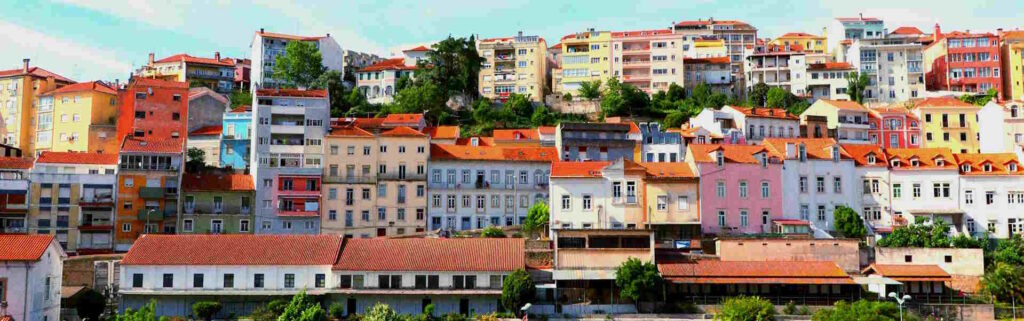
The cost of living in Coimbra is well below that of Lisbon on most measures, though the figures vary depending on what’s being counted.
According to Numbeo, property in Coimbra averaged €2,287 per square meter in February 2026, with asking rents at €12.8 per square meter that same month.
For contracted rents rather than asking prices, Coimbra municipality recorded a median of €9.48 per square meter in the first quarter of 2026, compared with €17.42 in Lisbon, according to INE. The gap between those two figures is the gap between what landlords ask and what tenants actually sign.
For monthly budgeting, a one-bedroom apartment in the city center runs around €860, or about €590 in the suburbs. Groceries come to roughly €170 for a single person, and a monthly transport pass is €30.
Nationally, Numbeo puts single-person costs at about €674, excluding rent, and a family of four at around €2,435, with utilities for an 85-square-meter flat averaging €118.94 and broadband €36.47.
Eating out stays cheap: about €10 for a main course at an inexpensive restaurant, €14 for a mid-range meal, €1 for a coffee, and €2-€4 for a beer.
For a direct comparison, Numbeo estimates that you’d need about €3,557 in Coimbra to match a €4,800 standard of living in Lisbon, assuming you rent in both places.
Two things shape the market. The university drives rental demand, which keeps prices firm in the center and around Celas, near the faculties and the hospital. Quieter residential areas north of the center attract long-term residents and families rather than students and cost less.
The affordability question depends on income. Portugal’s minimum wage reached €920 a month in 2026, and the OECD reported in April 2026 that housing prices had doubled in a decade relative to family incomes. Cheap by Western European standards does not mean cheap on a Portuguese salary.
Coimbra is compact enough that many residents walk for most of their needs. The complication is the terrain. Distances that look short on a map can involve a steep climb, so judge routes by the walk rather than the distance.
Buses
SMTUC runs the city bus network, covering both the upper and lower parts of the city. Routes and frequencies vary by area and by time of day, so check the specific route serving any address you’re considering before you commit to it. An existing route is not the same as a route that runs when you need it.
Walking and cycling
The Baixa and the riverside are flat and easy on foot. Alta and the university quarter are not, and the climb from the river to the top of the old town is steep enough to shape where people choose to live. Cycling works along the river, less so up the hill.
Trains
Coimbra has two stations. Coimbra-B, outside the center, handles long-distance services, and Coimbra-A sits in the city, connected by a short shuttle. Lisbon and Porto are both reachable in around two hours on fast services, longer on regional trains.
Driving
A car is useful in the region and on the coast, but less useful in the city itself. Parking in Alta and the historic center is genuinely difficult, and residents there often pay for a space rather than rely on the street. If you’re renting or buying, check whether parking is included and, if not, what it costs.
Healthcare
Portugal’s public health service, the Serviço Nacional de Saúde, provides care nationwide. Legal residents can register with their local health center to obtain an SNS user number, which provides access to appointments and referrals. What you’re entitled to depends on your residence status and registration details, so check your own position rather than assume general coverage applies.
Coimbra is well provided for by the standards of a city of its size, with both a hospital and a university teaching hospital capacity, along with health centers across the parishes. Private clinics operate alongside the public system, and many residents hold private insurance to shorten waiting times for non-urgent care.
Register with your local health center soon after you arrive rather than when you first need it. The registration process takes time, and it’s easier to complete when nothing is wrong.
Schools
Coimbra has state schools, private schools, and bilingual options. The choice is narrower than in Lisbon or Porto, which is worth knowing if international schooling matters to you.
State schooling is free and open to legal residents, with instruction in Portuguese. Private and bilingual schools charge fees and vary in the curriculum they follow and the extent of English instruction. Places at the smaller schools can be limited, so contact schools directly and early rather than assuming availability.
If school choice is driving your decision, first identify which schools you’d accept, then look for housing near them. Doing it the other way round tends to end badly here, because the options are fewer than in a larger city.
Everyday services
Supermarkets, pharmacies, banks, and post offices are spread across the residential parishes, so most daily needs are met close to home. Shopping centers at Solum and across the river at Santa Clara cover larger purchases. The Baixa has the traditional shopping streets, markets, and independent retailers.
Work and study
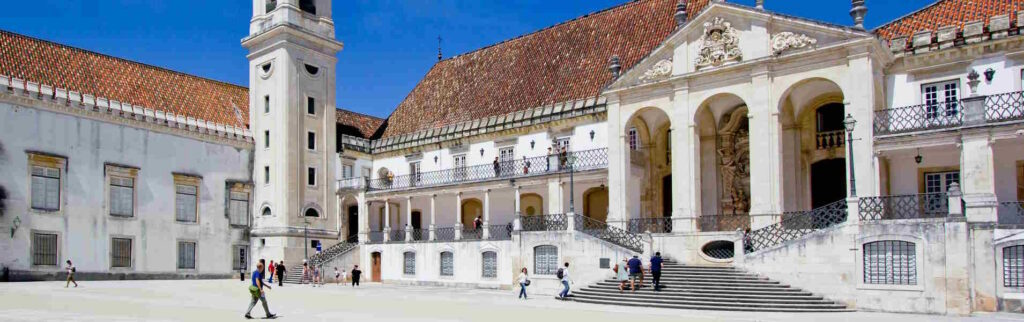
The University of Coimbra spans several campuses in the city and is the largest single employer and driver of economic activity. Health, education, and research account for much of the professional work, alongside the technology and services companies clustered around the university and the Instituto Pedro Nunes.
The local job market is smaller than Lisbon’s or Porto’s, and much of it operates in Portuguese. Most foreign residents who work here either arrive with a job, work remotely for an employer elsewhere, or run their own business.
Language
Portuguese is the working language of the city. English is common among students, university staff, and younger residents, less so in shops, with tradespeople, and in dealings with public services.
You can manage the first months in English in most everyday situations. You’ll struggle with a rental contract, a health center registration, or a builder who doesn’t speak Portuguese or have someone to help. Learning the language changes daily life here more than it would in Lisbon.
Weather
Summers are warm and dry, winters are cool and wet. Temperatures typically range from around 4°C in winter to 28°C in summer.
The point that catches people out is indoors, not outdoors. Older Portuguese buildings often have no central heating and limited insulation, and Coimbra’s damp winters make that noticeable. Check heating and glazing on any property you view, whatever month you’re viewing in.
Culture and regional access
The university shapes the cultural calendar. Queima das Fitas, the student festival held over eight days in May, is the largest event of the year. Fado de Coimbra, distinct from the Lisbon style and traditionally sung by men, is performed in venues across the city. The city also hosts jazz and wine events throughout the year.
Coimbra’s position makes the rest of the country accessible. The Silver Coast beaches, including Figueira da Foz, are around 45 minutes by car.
Aveiro, Lisbon, and Porto are all within a day’s reach. If you want the coast regularly without paying coastal prices, that combination is one of the practical arguments for living here.
Residence rules are national, so choosing this city over Lisbon or any other place in Portugal doesn’t change what you need or what you have to qualify for.
EU, EEA, and Swiss citizens can live in Portugal without a visa. If you’re staying longer than three months, you register with your local council and receive a registration certificate. Everyone else needs a national route that matches their income, work, or investment profile.
The most popular options are:
- Portugal D7 Visa: Retirees and others with stable passive income
- Portugal Digital Nomad Visa: Remote workers employed or contracted outside Portugal
- Portugal D2 Visa: Entrepreneurs and independent professionals starting or running a business
- Portugal Golden Visa: Investors qualifying through the eligible investment categories
Eligibility criteria, thresholds, and processing all sit with national authorities and change from time to time. Confirm the current requirements for your route before making housing decisions that depend on it, and see our overview of Portugal residence options for the full picture.
Tax residence is a separate question, and becoming a resident in Portugal has tax consequences that depend on your circumstances and your home country. Those are covered in our guide to Portuguese tax rules for expats.
What works
Housing costs less than in Lisbon, Porto, or the coastal cities, and your money buys more space. The city is compact, so daily life happens within a short radius.
Hospital and university capacity is unusually good for a city this size, which matters if healthcare access is part of your decision. Trains reach Lisbon and Porto in around two hours, and the coast is 45 minutes away by car.
Crime rates in Coimbra are low,w and the city is generally quiet. Take the same precautions you would in any city, particularly in busy central and nightlife areas, and be aware that pickpocketing occurs where crowds gather.
What to weigh against it
The city is built on a hill, and the address you choose determines how much that affects you. Housing stock in the center is old, and many buildings lack insulation and central heating, which is felt in winter.
Schooling and international options are fewer than in Lisbon or Porto. The nearest major airport is Porto, around an hour and a half away. Rental supply moves with the university calendar and tightens sharply before term. Property availability varies by area, so the flat you want may not exist where you want it.
The bottom line
Coimbra suits people who want a smaller Portuguese city with strong services, good transport links, and lower housing costs, and who don’t need a large international community or frequent flights.
It suits people wanting big-city amenities, wide school choice, or a flat walk everywhere considerably less well.
- Specialist expertise in Portugal residency planning
- Trusted by 15,000+ clients worldwide
- Over a decade of advisory expertise
- Dedicated relationship manager
- Transparent fees and guidance
- Support beyond approval
