
Portugal and Italy both attract retirees, but they suit different priorities. Portugal generally offers a more affordable cost of living and a simpler residency process through the D7 Visa, which is well suited to a fixed retirement income.
Italy offers deeper regional variety and cultural depth, and since Portugal’s NHR tax regime closed to new applicants, Italy’s tax treatment of foreign pensions is now often the more favorable of the two.
Which country fits you better depends on your budget, how much bureaucracy you’re prepared to navigate, and whether tax treatment of your pension income is a priority.
In this article, we’ll take a look at how Portugal and Italy compare as your retirement choice, the pros and cons of each country, and how to decide where to spend your Golden Years.

Portugal and Italy offer distinct lifestyles shaped by their climate, affordability, safety, healthcare, and leisure opportunities. While each country boasts a rich cultural heritage and picturesque landscapes, their day-to-day living experiences can differ.
According to our Global Intelligence Unit’s annual Global Retirement Report, Portugal came in first place in 2025. It notes that European countries such as Portugal, Spain, Austria, and France feature prominently among the safest and most welcoming, while also placing an emphasis on quality of life, healthcare, and overall living conditions.
Here’s a comparative look at these two European favorites across key aspects that matter most to retirees, residents and expats alike.
Weather
Portugal enjoys a mild Mediterranean climate, especially along its coastlines. Cities like Lisbon, Porto, and the Algarve region see warm, dry summers and mild, rainy winters.
The Algarve is particularly sunny, with over 300 days of sunshine annually and summer temperatures often reaching 30 to 35 degrees. Inland and island regions like Madeira offer even more climate diversity, but overall, Portugal is known for its pleasant weather year-round.
Italy has a more varied climate due to its length and geography. Northern Italy experiences cold winters, sometimes with snow, and warm, humid summers.
Central Italy, including Rome, has milder winters and hot summers, while southern Italy and the islands enjoy mild winters and very hot, dry summers, often surpassing 30 degrees. The north can be foggy and rainy, while the south is typically drier and sunnier.
Cost of living
Portugal is generally more affordable than Italy for day-to-day living, especially for housing outside the biggest cities; exact budgets depend heavily on location and lifestyle.
Dining, groceries, and utilities are generally cheaper than in neighboring countries, and even private healthcare is affordable. Lisbon and the Algarve are pricier than rural areas, but overall, Portugal offers a high quality of life at a modest cost.
Italy’s cost of living is broadly comparable to Portugal’s, though it varies more by region. The north and central regions, including Milan and Rome, are notably more expensive, while southern Italy can rival Portugal on price.
Groceries and dining are reasonably priced across most of the country, but rent in major cities is markedly higher than in Portugal.
Safety
Portugal consistently ranks as one of the world’s safest countries. Violent crime is rare, and the overall crime rate is low, with most incidents limited to petty theft in tourist areas.
The country’s political stability and friendly atmosphere contribute to a strong sense of security for both locals and visitors. In our Global Passport Index, Portugal ranks 30th and comes in 11th for quality of life.
Italy is also considered safe, with low rates of violent crime. Our Global Passport Index ranks Italy 24th, and in our Global Intelligence Unit’s Retirement Guide for US Citizens, Italy comes in 7th place overall, scoring 10th place for Quality of Life and 8th place for its weather.
Healthcare
Portugal provides universal healthcare through its publicly funded Serviço Nacional de Saúde (SNS), offering free or subsidized care to residents.
The system is robust, with high standards, but public facilities can be crowded. Private healthcare is available and affordable, with many English-speaking professionals. Portugal’s healthcare ranks well globally and is praised for accessibility and quality.
Italy also offers universal healthcare via the Servizio Sanitario Nazionale (SSN), widely recognized as one of the best in the world. Care is free or nearly free at the point of service, though waiting times can be long in public facilities.
Private insurance is available for faster access and more options. Italy boasts high life expectancy and excellent medical outcomes, though there are some regional disparities in service quality.
Leisure and entertainment
Portugal is celebrated for its vibrant outdoor lifestyle, beautiful beaches, and historic cities. Lisbon and Porto offer lively nightlife, music, and cultural festivals, while the Algarve is a hub for golf, water sports, and coastal relaxation.
The country’s culinary scene is rich with fresh seafood and local wines. Expats enjoy a strong sense of community, frequent festivals, and easy access to nature.
Italy is a global icon of culture, art, and cuisine. From Rome’s ancient ruins to Florence’s museums and Venice’s canals, the country is a playground for history buffs and art lovers.
Italian cities are famous for their cafés, vibrant markets, operas, and festivals. The Mediterranean lifestyle emphasizes leisurely meals, social gatherings, and outdoor activities – many consider Italian food the best.
From skiing in the Alps to sunbathing on the Amalfi Coast, Italy offers endless options for entertainment and exploration.
Portugal D7 Passive Income Visa
The Portugal D7 Visa is a residence visa program that allows non-EU citizens with sufficient passive income to live in Portugal without working. It’s particularly popular with retirees, real estate investors, and those who rely on passive income from sources like pensions, investment income, or royalties.
Among the criteria, meeting the minimum income requirement is crucial for the Portugal D7 Visa. You must demonstrate a stable and regular passive income that is at least equivalent to the Portuguese minimum wage, which is €920 per month since January 1, 2026, under Decreto-Lei n.º 139/2025. This income can come from various sources, such as:
- Social Security benefits (Pensions)
- Rental income
- Dividends
- Transferable equity
- Intellectual property
Additionally, you must provide Portuguese bank statements showing a minimum balance equal to one year’s minimum wage (€11,040) during your two-year application period. This amount is calculated as €920 x 12 months.
Italy Elective Residency Visa
Italy doesn’t have a dedicated visa for retirees like Portugal. However, there is a similar retirement option aimed at financially independent people.
Called the Italy Elective Residency Visa or Residenza Elettiva, it is a long-term visa for non-EU citizens who have sufficient financial resources and want to live in Italy without working. It is especially suited for retirees or individuals with passive income from pensions, investments, or rental properties.
To qualify for the Italy Elective Residency Visa, applicants must prove a steady stream of passive income. Italian law does not set a fixed statutory amount; instead, it requires income that is “ample, stable and regular.”
In practice, consulates generally expect a passive income of roughly €31,000–€32,000 per year for a single applicant, around 20 percent more for a couple, with additional amounts per dependent. These figures vary by consulate, so it’s worth confirming the exact threshold with the consulate handling your application.
Savings alone do not qualify as stable passive income, but may support the application.ce for quality of life and 6th for enhanced mobility.

Portugal’s D7 Visa and Italy’s Elective Residency Visa are two of the most accessible pathways for non-EU citizens looking to settle long-term.
Both are designed for individuals with stable passive income, such as pensions or investments, but they differ in income requirements, timelines, and day-to-day conditions.
Choosing between Portugal’s D7 Visa and Italy’s Elective Residency Visa largely depends on your financial situation, lifestyle preferences, and long-term goals.
Portugal’s D7 Visa is considered more accessible: it requires proof of sufficient passive income set at the level of the national minimum wage, and offers a defined path to permanent residency and citizenship.
Italy’s Elective Residency Visa has higher financial expectations and doesn’t allow you to work, though owning real estate in Italy may support your application.
If affordability and a more straightforward visa process are your priorities, Portugal’s D7 Visa is likely the better fit. If you have a higher income and are drawn to Italy’s culture and regional lifestyle, the Elective Residency Visa could suit you well.

Taxation is one of the biggest differences between retiring in Portugal and retiring in Italy, and it has shifted meaningfully in the past two years.
Portugal’s Non-Habitual Resident (NHR) regime, which once gave new foreign residents a reduced tax rate on foreign-sourced pension income, closed to new applicants after its transitional window ended on March 31, 2025.
Its successor, the IFICI regime (sometimes called “NHR 2.0“), excludes pension income entirely. This means new foreign retirees moving to Portugal now pay standard progressive IRS rates on their pension income, rather than the preferential rate NHR once offered.
Italy takes a different approach for a specific group of retirees. Foreign pensioners who move their tax residence to qualifying smaller municipalities across southern Italy can opt into a 7% flat tax on foreign income, including pensions, for up to 10 years, under article 24-ter of the Italian tax code (TUIR), in force since 2019.
Taken together, this is a meaningful shift from a few years ago: tax treatment of pension income now often favors Italy over Portugal, a genuinely useful distinction for retirees weighing the two countries that most comparisons overlook.
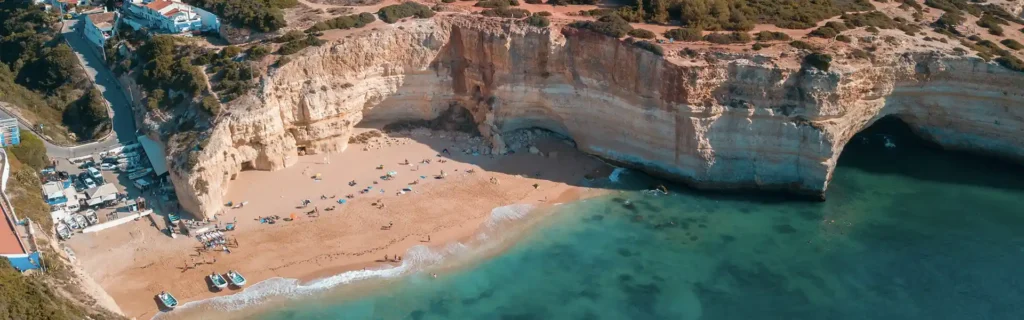
1. Algarve: The Algarve is a top retirement destination in Portugal, famous for its over 300 sunny days, stunning beaches, and excellent golf courses.
2. Cascais: Cascais combines cosmopolitan living and coastal charm. Once a royal retreat, it’s now popular among retirees for its clean beaches, scenic promenades, and quality amenities.
3. Coimbra: Coimbra offers a cultural charm for retirees seeking an inland option. Known for its prestigious university and historic architecture, it’s more affordable than coastal areas, featuring traditional restaurants, local music, and festivals.
4. Évora: The historic city of Évora, a UNESCO World Heritage Site in Alentejo, is perfect for retirees wanting a quiet, culturally rich lifestyle with its cobblestone streets and vineyards.
5. Funchal, Madeira: Funchal, the capital of Madeira, is great for retirees seeking mild weather and a relaxed atmosphere. Surrounded by stunning mountains and ocean views, it offers good healthcare, fresh markets, and outdoor activities.

1. Tuscany (Lucca): Lucca is a charming retirement destination with Renaissance walls, cobbled streets, and proximity to Florence and Pisa. It offers a relaxed pace, vibrant culture, and excellent healthcare. Retirees can enjoy markets, concerts, and a café scene, with more affordable housing compared to nearby cities.
2. Sicily (Taormina): Taormina features stunning views of the Ionian Sea and combines ancient ruins with Mediterranean culture. It’s perfect for retirees seeking warmth and tranquility, with a low cost of living and good healthcare access in nearby Catania.
3. Puglia (Lecce): Lecce, known as the “Florence of the South,” offers a slower pace and lower living costs. With beautiful beaches and traditional cuisine, it appeals to retirees who appreciate history and a vibrant cultural scene.
4. Lake Garda (Desenzano del Garda): Desenzano del Garda offers stunning Alpine views and outdoor activities. It has modern amenities, a top-rated healthcare system, and affordable housing options, making it attractive for active retirees.
5. Marche (Ascoli Piceno): Ascoli Piceno is an affordable retirement option with historic charm and a tranquil atmosphere. Its low cost of living and solid healthcare, along with close proximity to the Adriatic coast, make it ideal for those seeking authenticity and scenic beauty.
Portugal and Italy are both strong choices for retirement, but they suit different priorities. Use the checklist below to see which one lines up better with what matters most to you.
Pick Portugal if:
- Affordability is your top priority. Portugal is generally the more budget-friendly country for day-to-day living, especially outside the biggest cities.
- You want a simpler, more predictable visa process. The D7 Visa has a clear income requirement tied to the national minimum wage.
- You’d rather handle things in English. Portugal has strong English proficiency in its major cities and expat hubs.
- You want milder, more consistent weather. Portugal’s coastline, especially the Algarve, offers warm summers and mild winters year-round.
Pick Italy if:
- Tax treatment of your pension matters most. Italy’s 7% flat-tax regime for qualifying retirees can be more favorable than Portugal’s standard rates now that NHR has closed to new applicants.
- You want deep cultural and regional variety. Italy’s cities, food, and history offer a different kind of daily life from region to region.
- You’re comfortable with more bureaucracy. Italy’s residency process involves more paperwork and consulate-dependent requirements than Portugal’s.
- Climate variety appeals to you. Italy ranges from snowy winters in the north to hot, dry summers in the south, so you can choose the climate that suits you.
Both countries let you pursue long-term residency and eventual citizenship, and both offer good healthcare and safety. The right choice comes down to how you weigh affordability, tax treatment, language, climate, and how much bureaucracy you’re willing to navigate.
Why choose Global Citizen Solutions for your Immigration Visa?
GLOBAL APPROACH BY LOCAL EXPERTS
- GCS has offices located across Portugal.
- Members of the US-Portugal and UK-Portugal Chambers of Commerce in Portugal, and the Investment Migration Council (IMC).
- Our expert team can help you throughout your journey to secure your Visa.
100% APPROVAL RATE
- Our successful track record in applications provides reassurance to applicants.
- We have helped clients from more than 35 countries secure residency in Portugal.
ALL-ENCOMPASSING SOLUTION
- With a single channel of communication, our approach ensures that you have complete clarity on your application.
- Our BeGlobal® Onboarding System allows for a total flow of information.
TRANSPARENCY AND PRIVACY
- Our pricing is clear and detailed, you will not face any hidden costs.
- All data is stored within a GDPR-compliant database on a secure SSL-encrypted server.
