Living in Serbia: Life, Work and Moving Guide 2026

Living in Serbia means having a much lower cost of living than in many Western European countries. It also means living in a country with a growing technology sector, a strong social culture, and a choice of lively or quieter cities. Belgrade and Novi Sad have the best job opportunities and international communities, while cities such as Niš, Subotica, and Kragujevac offer a slower-paced lifestyle and lower living costs. 

At Global Citizen Solutions, we know that moving to a new country involves more than deciding where to live. Understanding your residency options, investment requirements, cost of living, and long-term prospects is an important part of deciding whether Serbia is the right fit for you. 

This guide gives you a practical overview of what it takes to live in Serbia, including legal pathways to residency such as investment, employment, family reunification, and other qualifying routes, as well as housing, healthcare, education, transport, and everyday living costs. 

Living in Serbia: Key Takeaways

Serbia offers a lower cost of living than many Western European countries, while Belgrade and Novi Sad provide strong access to jobs, technology, international communities, and modern amenities.  
Foreigners have several ways to establish legal residence in Serbia, including Serbia Residency by Investment, property ownership, employment, family reunification, education, and other qualifying routes.  
Temporary residence can generally be granted for up to three years, while eligible foreigners can apply for permanent residence after three years of continuous temporary residence, subject to the relevant requirements.  
Belgrade has Serbia’s strongest job market and highest cost of living, while Novi Sad, Niš, Subotica, and Kragujevac offer different combinations of affordability, employment opportunities, and lifestyle.  
Serbia’s IT sector offers some of the country’s strongest salaries, although average earnings remain below Western European and North American levels. In May 2026, the average monthly salary was around US$1,565 gross and US$1,134 net. 

Pros and Cons of Living in Serbia

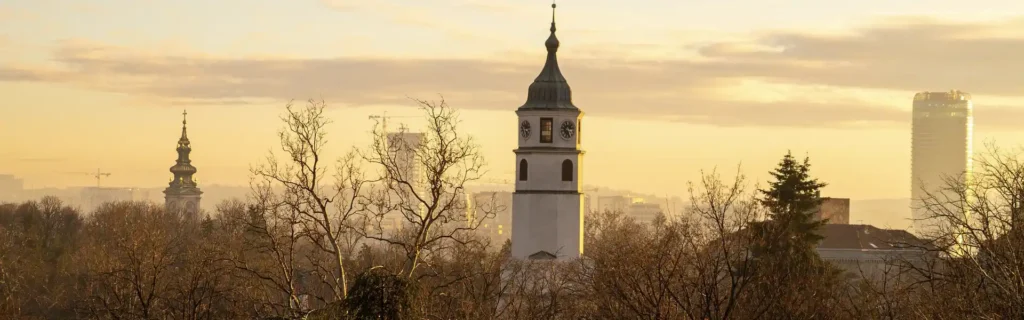
View of towers in Belgrade, Serbia, during sunrise

Pros

  • Lower cost of living than many Western countries: Rent, dining out and everyday services in Serbia cost less than in Western Europe. For instance, London is 73% more expensive than Belgrade meaning Serbia’s capital is 44% cheaper.  
  • A social, food-focused culture: Long meals with friends and family are part of everyday life, and hospitality toward guests is a genuine part of Serbian culture. 
  • Growing IT and tech sector: Belgrade and Novi Sad in particular have active tech and startup scenes, which have drawn a steady stream of foreign professionals and remote workers. 
  • Scenic, varied geography:  From the Fruška Gora hills near Novi Sad to national parks and mountain regions further south, Serbia has a lot of accessible natural landscape for a relatively small country. 
  • English is common in the cities: In Belgrade, Novi Sad and Niš, many people.  especially younger residents, speak conversational or fluent English, which makes early integration easier. 

Cons 

  • Wages are low by European standards: Despite rising nominal wages, average earnings in Serbia remain well below Western European levels. Serbia’s net minimum wage is approximately €457 per month, or around €619 gross, which is around four times lower than Germany’s €2,343 gross minimum wage and more than four times lower than Luxembourg’s €2,704 gross minimum wage. 
  • Bureaucracy can be slow: Residence, work permit and public-service processes in Serbia often take longer and require more paperwork than expats from Western Europe or North America may be used to. 
  • Public healthcare capacity is strained in places: Wait times for public healthcare can be long, particularly outside Belgrade, which is why many expats budget for private insurance or private consultations.  

Best Cities to Live in Serbia

CityBest forPaceJob accessTrade-offs
BelgradeCareer-focused expats, entrepreneurs, nightlifeFast, capital-city energyStrongest job and business market, with a hub for IT and multinational officesHighest rents and cost of living in the country; can feel crowded
Novi SadFamilies, remote workers, a calmer paceRelaxed, walkableSmaller but growing job market, with some IT presenceFewer large-employer options than Belgrade; smaller international community
SuboticaCross-border commuters, digital nomads wanting proximity to Central Europe, heritage loversVery quiet, European border-town feelNiche local roles, light manufacturing, and logistics; best suited for remote workersSmall expat community; highly dependent on Hungarian language skills outside tourism and tech
KragujevacIndustrial specialists, automotive engineers, budget expatsIndustrial, steady regional hubSolid manufacturing, automotive, and engineering sectors; modest local IT sceneLimited English-speaking service sector; minimal international social scene
NišBudget-conscious movers, culture and history enthusiastsSlower, more localLimited job market, especially in techSmallest expat networks; English is less consistently spoken outside the centre

There is no single Serbia residency program. Instead, foreigners can obtain temporary residence permit through several legal routes, including employment, buying property in Serbia, investment through programs like the Serbia Residency by Investment,  family reunification, education, and digital nomad status.

Residence route / permitWho it’s forKey condition
Serbia Residency by InvestmentForeign investors investing in a registered Serbian companyRequires proof of investment in tangible or intangible assets and at least €50,000 in a Serbian bank account
Serbia Single PermitForeigners working for a Serbian employer, including certain self-employed workers and independent professionalsRequires an eligible employment basis and provides combined residence and work authorisation
Serbia Digital Nomad VisaForeign nationals working remotely for a foreign employer or businessMust meet Serbia’s requirements for temporary residence as a digital nomad
Serbia Property Owner ResidenceForeigners who own qualifying real estate in SerbiaRequires proof of property ownership, adequate health insurance, and sufficient funds
Serbia Family Reunification ResidenceQualifying family members of Serbian citizens or foreign residentsRequires proof of the qualifying family relationship
Serbia Student ResidenceForeign nationals studying or undertaking recognised education in SerbiaRequires proof of enrolment or another qualifying educational activity
Serbia Start Up ResidenceForeign nationals establishing or participating in a qualifying Serbian start-upMust meet the requirements for the start-up basis of temporary residence

Every route is an application basis, not a guaranteed outcome. Applicants must still meet the relevant eligibility and documentation requirements, and applications are assessed on a case-by-case basis for each Serbian residency permit.  

The three stages after approval 

StageWhat it meansDuration
1. Temporary residenceResidence granted based on your approved legal basisUp to 3 years, renewable depending on the basis
2. Permanent residenceA separate and more stable residence statusEligible to apply after 3 years of continuous temporary residence, subject to conditions and limits on time spent abroad
3. Serbian CitizenshipA separate legal process from residenceAssessed individually and not automatic after obtaining permanent residence
serbia flags

Read our Serbia Residency by investment guide  

Serbia’s Public Transport System

  • Urban and city transport: Public transport in Serbia’s cities is managed by local authorities. In Belgrade, the network includes buses, trams, trolleybuses, and the BG Voz urban rail system. The city uses time based mobile ticketing through SMS or an app, as well as prepaid contactless paper cards. Novi Sad, through JGSP Novi Sad, and Niš, through the Directorate for Public Transport, also operate extensive local bus networks. Tickets can be paid for with cash or contactless local transport cards. 
  • Intercity buses: Long distance travel in Serbia relies heavily on coaches operating from central bus stations, such as Belgrade’s BAS. Tickets can be bought at station ticket counters or directly from major operators such as Lasta and Niš-Ekspres
  • Passenger rail: Serbia’s national passenger rail network is operated by the state owned company Srbija Voz. It includes the high speed Soko (Falcon) trains, which connect Belgrade, Novi Sad, and Subotica and can reach high speeds. 

Serbian Education System

Education in Serbia is overseen by the Ministry of Education and is divided into four main levels: 

Education levelTypical ageStructure
Preschool / Kindergarten3 to 6.5Early childhood education
Primary School / Osnovna Škola6.5 to 15Grades 1 to 8
Secondary School / Srednja Škola15 to 19Gymnasium or vocational school
Higher Education18+Universities and applied sciences

Education options for foreign residents 

  • Public schools: Public education is taught in Serbian. Primary education is compulsory and free for foreign residents who hold temporary residence (privremeni boravak).  
  • Private and international schools: These are often the preferred option for foreign families. Most international schools are in Belgrade and Novi Sad and offer international curricula in English, French, or German, including IB, British IGCSE and A Levels, and American High School Diplomas.  

International school costs in Serbia  

Tuition fees vary depending on the curriculum, grade level, and school, but for expats looking to explore international schools in Serbia these are average estimates of private education in Serbia.

CategoryAnnual tuitionExamples
Top tier international€15,000 to €25,000+International School of Belgrade (ISB)
Mid range British / IB€8,000 to €15,000Chartwell International, British International School, Brook Hill
Bilingual / National curricula€5,000 to €9,000French School (École Française), German School (DSB), Ruđer Bošković

Working in Serbia as a Foreign National  

people working

Serbia’s job market is different depending on the region. Belgrade and Novi Sad have the strongest opportunities, particularly in technology, while opportunities are more limited in the south and rural areas. 

 The IT sector is a standout, with salaries above the national average, although they remain below comparable Western European and North American salaries.  

In May 2026, the average monthly salary was RSD 163,470 gross (about $1,565) and RSD 118,398 net (about $1,134), according to Serbia’s Statistical Office. Foreigners must also have the appropriate work authorisation or residence and work permit to work legally in Serbia. 

Housing and Monthly Living Expenses in Serbia

Foreigners in Serbia can rent or buy apartments, houses, townhouses, or shared accommodation, with newer, Western-style developments increasingly replacing or renovating older residential properties, particularly in Belgrade and Novi Sad. Foreigners can also buy property in Serbia in most cases, provided their home country has a reciprocity agreement with Serbia. 

Additionally, when planning your budget, allow extra room for utilities, internet, and building fees.  

Cost of LivingBelgradeNovi SadNiš
1-bed apartment, city centre87,519 RSD (~$859)52,277 RSD (~$515)40,458 RSD (~$398)
1-bed apartment, outside centre60,278 RSD (~$592)42,964 RSD (~$423)29,304 RSD (~$288)
Basic utilities, 85m² apartment22,688 RSD (~$223)24,474 RSD (~$241)16,350 RSD (~$161)
Single person, monthly costs excl. rent82,954 RSD ($815)81,952 RSD ($807)59,984 RSD ($590)
Average net salary127,128 RSD (~$1,248)123,866 RSD (~$1,219)91,907 RSD (~$904)
Monthly public transport pass0 RSD (Belgrade’s city transport is currently free)2,566 RSD (~$25)0–2,640 RSD depending on route

Why Work with Global Citizen Solutions? 

  • Trusted by 15,000+ clients worldwide 
  • Over a decade of advisory expertise 
  • Dedicated relationship manager 
  • Transparent fees and guidance 
  • Support beyond approval 
icon-logo-star-blue

Frequently Asked Questions

Serbia can suit foreigners who value lively cities, a strong social culture and costs that may be lower than many Western capitals. Whether it's a good fit for you depends on your income, language commitment, healthcare expectations, tolerance for bureaucracy and choice of city.

Serbia is manageable with ordinary caution, not universally risk-free. The current US advisory places Serbia at Level 2, citing crime as the main concern; violent incidents are most often linked to organized crime or high-profile sporting events, and it's best to avoid demonstrations, which can turn unpredictable.

Yes, when their immigration status authorizes work. Employment and self-employment commonly require a D visa or a residence-and-work single permit, and the official government portal determines which route applies to your situation.

No. Property ownership is a recognised basis for applying for Serbian residence, but buying a property does not automatically guarantee approval. Applicants must still meet the relevant eligibility and documentation requirements. Serbia Residency by Investment is a separate route, officially referred to by the Serbian government as “Visa for investors,” and is based on qualifying investment rather than property ownership alone.

No. Self-employment can support a visa or single-permit application, but registering a company alone does not guarantee that immigration status will be approved.

No, Serbia does not have an officially designated “digital nomad visa.” However, remote workers can still live in Serbia long term through other legal residence options, such as starting a local business, buying qualifying real estate, or applying through another standard temporary residence route. 

Yes, Americans can live in Serbia. US citizens can enter Serbia visa free for up to 90 days within any 180 day period. For longer stays, they need to apply for temporary residence through routes such as starting a local company, buying qualifying real estate, employment, or study. 

In Belgrade, Novi Sad and Niš, many residents  especially younger people  speak conversational or fluent English. Outside the main cities, English is less consistent, and learning at least conversational Serbian is strongly recommended for daily life and bureaucracy. 

Serbia offers a moderate quality of life compared with Western Europe: a lower cost of living, a generally manageable safety picture and a strong social culture are real advantages, while relatively high unemployment, bureaucratic friction and strained public-service capacity in places are genuine trade-offs to weigh. 

Share this post:

Explore More Resources

Is Serbia safe in 2026? Learn about crime, travel risks, road safety, and local laws, plus essential tips for visitors, expats, and long-term stays.
Discover the cost of living in Serbia in 2026,including accommodation, food, studies, and more
Discover the top international schools in Serbia for expats in 2026. Compare curricula, fees, locations, and tips for choosing the right school for your child.
Privacy Overview
Global Citizen Solutions logo featuring a stylized globe and modern typography in blue and green colors.

We are using cookies to give you the best experience on our website. You can find out more about which cookies we are using or switch them off in settings. For more information, please visit our Cookie Policy.

Strictly Necessary

Strictly Necessary Cookie should be enabled at all times so that we can save your preferences for cookie settings.

Analytics

This website uses Google Analytics to collect anonymous information such as the number of visitors to the site, and the most popular pages.

Keeping this cookie enabled helps us to improve our website.

Marketing and Advertising

This website uses the following additional cookies:

(List the cookies that you are using on the website here.)